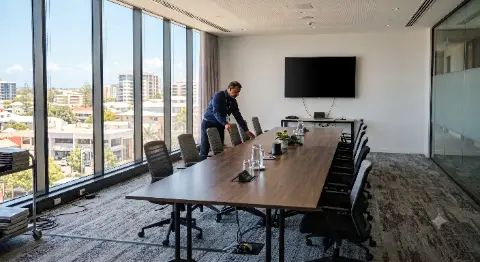
Multi-space event venues need software that manages a live function diary across all spaces, catches scheduling conflicts automatically, handles MICE-specific financial structures, and integrates with the property management system. For operators running more than one site, multi-property capability — a single platform portfolio— matters as much as any individual feature.
At one event space, experience and a good memory cover most of what the software misses. Scale that to five spaces and the same approach stops working.
Even the best venue staff can only hold so much in their heads at once. At a certain point, a venue management system either carries that complexity or the team does. And when the team is carrying it, errors follow.
For multi-space operators, MICE activity accounts for 20–40% of total hotel income at many properties, and in venues where events are the primary business, that figure runs higher. A system that slows proposals, produces errors, or leaves teams working from different information costs bookings.
Where things go wrong in multi-space venue management
The diary nobody fully trusts.When a venue management system doesn't give every relevant team member a reliable, real-time view of what's booked, tentative, and available, people build workarounds. Once that culture takes hold, the system loses its usefulness, and every workaround becomes a potential source of error that reaches the client. | Resources with no shared visibilityTwo events running in the same building on the same day share the AV team, the linen supply, the kitchen pass. Software that treats each booking as an isolated transaction pushes the coordination problem onto operations staff. They solve it through experience and phone calls, until volume makes that unsustainable. | Revenue data that can't be measuredHospitality revenue strategist Birgit Haake has pointed out that KPIs like space utilisation rates and revenue per available square metre are rarely established in hotel MICE operations. Most multi-space venues make decisions with an incomplete picture of their own performance, largely because the data sits across systems that don't talk to each other. |
|---|
For groups running multiple sites, there's often no meaningful portfolio view. Consolidated data on bookings, revenue, and space utilisation across properties usually means manual exports and spreadsheet reconciliation. This data paints a picture of last month, not of right now.
What multi-venue properties need in venue management software
A function diary the whole team relies on
Multi-space venues need a function diary that shows every space, every configuration, and every booking status in a single view, updated in real time and accessible to whoever needs it. The moment any team member works from a different version, there's a reliability problem that tends to surface at the worst possible moment.
Room configurations add another layer. Venue software needs to understand the relationship between a full room and its breakout sections, so that selling both to different clients on the same day isn't something a manager discovers the morning of the event.
Conflict detection that doesn't depend on staff
Venue management software should catch incompatible bookings, committed resources, and capacity problems automatically. Multi-space venues can't rely on coordinators cross-referencing availability manually across spaces, configurations, and shared resources. By the time a conflict surfaces through that process, it's usually landed on the operations team's desk on the day.
Financial management built for MICE
MICE venues need financial functionality that generic event booking tools weren't built for:
Group accommodation blocks linked to event bookings, with attrition tracking and release date management
Configurable delegate package pricing — day delegate rates, 24-hour packages, per-head structures for different event types
BEOs that auto-populate from the booking record, rather than requiring a coordinator to re-enter the same information into a separate template
Commission tracking for agent and marketplace bookings, given how much MICE volume moves through those channels
Venues handling these requirements without the right venue software end up building the missing functionality from spreadsheets. That works up to a point, and then the error rate catches up with the volume.
PMS integration
For hotel properties, the venue management system and the PMS need to share information in real time. Room blocks tied to events need to sit within the broader room inventory picture — displacement decisions depend on it, and so does any meaningful total revenue reporting per event.
Without that connection, revenue managers make group versus transient decisions with incomplete data. The same accommodation block might appear in the event system but not in the PMS until someone reconciles the two by hand. Native integrations with Opera, Mews, or Protel close that gap and put total event revenue in one place.
Multi-property that means multi-property
For operators managing more than one site, multi-property capability means a single instance of the platform running across the portfolio, not a separate login and instance per property. A platform that requires the latter is really several single-property systems sitting next to each other.
Portfolio-level capability means a single view of bookings across all sites, consolidated reporting, and the ability to redirect an enquiry from a fully booked property to another in the group without doing it by hand.
Event booking software vs. venue management platforms
Event booking tools are built around the sales workflow — capturing leads, generating proposals, tracking pipeline conversion. They do that well, particularly for single venues with high inquiry volume and relatively straightforward events. The operational depth multi-space hotel venues require is where they reach their limits.
Enterprise venue management platforms cover the full event lifecycle, with deeper functionality around space management, resource coordination, MICE financial management, and system integrations. Hotel conference centres, resort properties, and multi-site operators get the most value from these.
Why proposal speed affects bookings
Slow proposal turnaround costs multi-space venues bookings. MICE planners send enquiries to multiple venues simultaneously, and response speed genuinely affects conversion. A team that checks availability in one system, pulls F&B menus from a shared drive, opens a separate pricing document for delegate rates, and then builds the proposal in a different template is already behind.
33 hrs
| At 50 enquiries a month, the difference between a 20-minute proposal and a 60-minute one is 33 hours of sales capacity. That's either time recovered or proposals going out slower than a competitor's. |
|---|
Where AI helps multi-venue properties
The AI capabilities most useful to multi-space venues are administrative rather than strategic. An AI agent that responds to an inbound enquiry, checks availability, and returns a preliminary proposal outside business hours has real value at volume. Complex MICE enquiries still need experienced staff to review before anything reaches a client.
The stronger case for AI is removing the administrative work around the skilled work: populating BEOs from booking data, generating run sheets, flagging scheduling conflicts, drafting initial proposals for human review.
How to evaluate a platform before you commit
The instinct is to book a demo and watch the product perform well under controlled conditions. For multi-space venue management, bring your own scenarios instead.
Run five concurrent events across your spaces and watch how the diary holds up
Generate a BEO from a booking record
Process an attrition adjustment on an accommodation block
Pull a space utilisation report for a quarter
Ask where the manual steps are. If the system handles all of that without gaps, it's built for the job. If the answer to several of those questions is "you'd export that to Excel," that tells you what the next two years of operations will look like.
FAQ
What's the difference between event booking software and venue management software?
Event booking software is built around the sales pipeline — leads, proposals, conversion tracking. Venue management software covers the full event lifecycle, including space and resource coordination, MICE-specific financial management, and integrations with systems like a hotel's PMS.
Does venue management software need to integrate with a PMS?
For hotel properties, yes. Without a live connection between the event system and the PMS, room blocks tied to events sit outside the main inventory picture, which makes displacement decisions and total revenue reporting harder to get right.
What does "multi-property" mean in venue management software?
It means one instance of the platform running across every site in a portfolio, with a single view of bookings and consolidated reporting — not a separate login and database for each property.
How much of hotel revenue comes from MICE business?
MICE activity typically accounts for 20–40% of total hotel income, and often more at venues where events are the primary business.
Where does AI add the most value in venue management?
In administrative tasks rather than strategic ones, like auto-populating BEOs, generating run sheets, flagging scheduling conflicts, and drafting initial proposals for a human to review. Complex enquiries still need experienced staff.